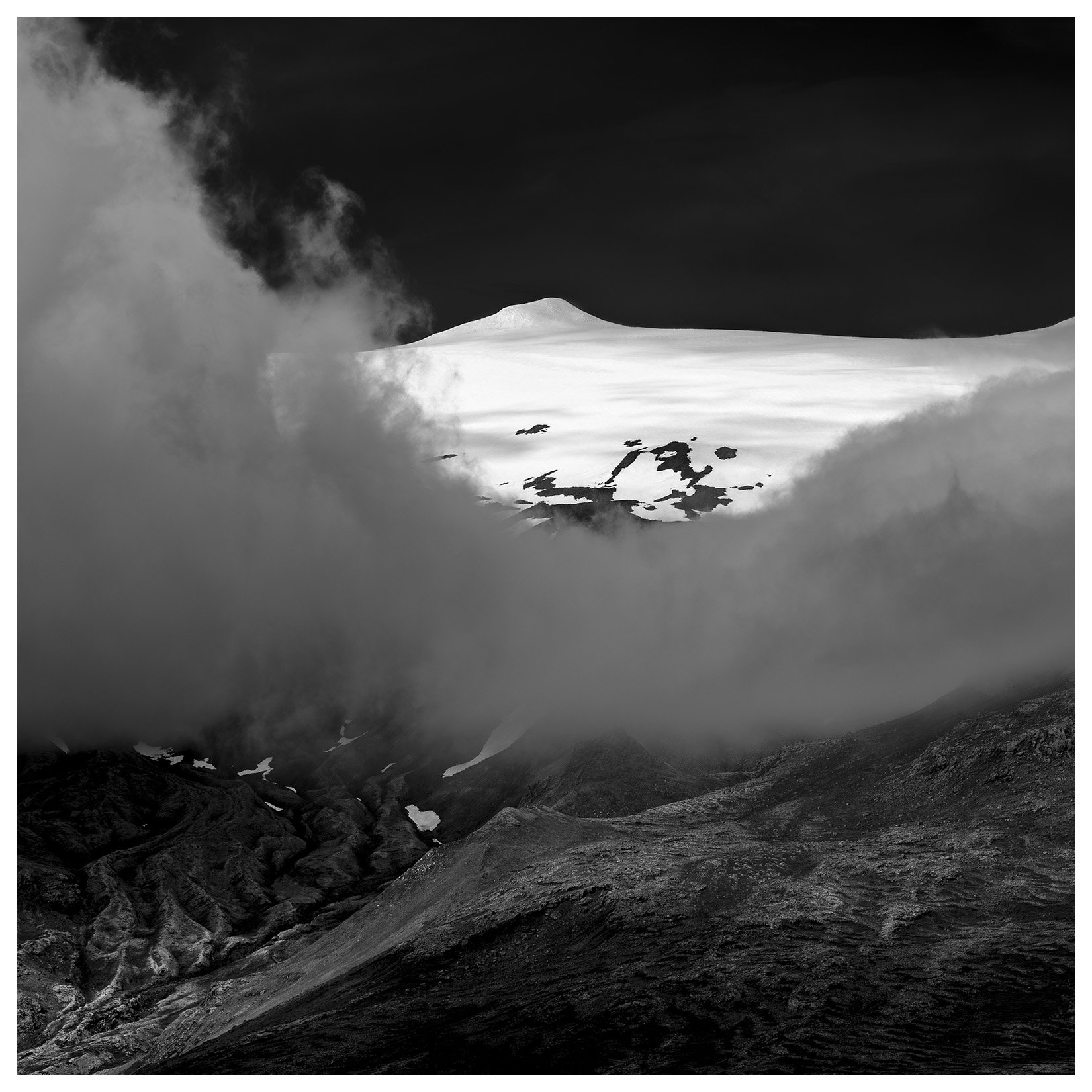
Snaefellsjokull
Camera
LEICA M11 Monochrom
Lens
Leica APO-Telyt M 135mm f/3.4
Exposure
1/1000s @ f/4
Filters
None
Print Sizes
8”x8”
16”x16”
20”x20” (max. size @300dpi)
Peizography Prints
Hahnemühle Photo Rag Baryta (Gloss)
Canson Infinity Rag Photographique II (Matte)
Giclée Prints
Canson Baryta Prestige II
Hahnemühle FineArt Baryta
Inquire About Prints
Snæfellsjökull: A Study in Ice, Shadow, and Icelandic Myth
Rising from Iceland’s far western edge, Snæfellsjökull feels less like a mountain and more like a presence. It was a magical hour of constantly changing light, high winds, and swirling clouds on a late June afternoon. Choosing to stay put required patience, but faith in Iceland’s famously unpredictable weather paid off as the scene transformed in an instant. This image stands among my best work, and the print is truly exquisite — the web simply doesn’t do it justice.
Standing 1,446 meters high on the tip of the Snæfellsnes Peninsula, Snæfellsjökull is both volcano and glacier, its ice cap concealing a dormant volcanic core. The surrounding lava fields and coastal plains contribute to the stark visual language of the scene, elements that become especially powerful when reduced to tonal contrast and form.
The mountain anchors Snæfellsjökull National Park, the only national park in Iceland that extends from the sea to a glacier, and on clear days it is visible even from Reykjavík. Its commanding position at the edge of the Atlantic makes it one of the country’s most iconic natural landmarks.
Beyond geology, Snæfellsjökull holds deep cultural significance. Immortalized by Jules Verne as the gateway in Journey to the Center of the Earth and steeped in Icelandic folklore, it carries an aura of mystery that resonates strongly in monochrome. In black and white, the mountain becomes not just a landscape, but a meditation on endurance, scale, and the quiet power of nature.